
NDIS Price Guide 2025: Price cuts means supports cut?

Each year, the National Disability Insurance Scheme (NDIS) completes a review of the pricing arrangements for all services, supports, and items available to NDIS participants. On Thursday 12th June, the NDIS released the newest Price Guide in line with the recent review outcomes, which has caused quite a stir on social media amongst participants and providers. The changes, which come into effect on the 1st of July, include billing for smaller periods of time to improve flexibility, releasing participant funding on a quarterly basis rather than annually, reduced rates for therapy providers, implementing a national rate for psychologists which means increases for some states and decreases for others, as well as capping providers charging travel costs to only 50% of the time travelled.
You can read the full guide here: https://www.ndis.gov.au/providers/pricing-arrangements/making-pricing-decisions/annual-pricing-review
Providers are reasonably frustrated with this outcome, as reduced fees and billing only 50% of travel will impact businesses’ ability to provide support at the same level. However, many participants of the NDIS and their family members are reporting feeling happy with the changes, citing dodgy and greedy providers’ price gouging as the reason many participants aren’t receiving the required support.
Participants are unhappy with providers.
Following the release of the reviewed price guide, it appears participants aren’t feeling too sorry for NDIS providers and have responded online to the tune of “providers are already being paid above the average wage, they’ll be fine with a $10 pay cut”. Some participants have even taken to social media to share their negative experiences with NDIS providers.
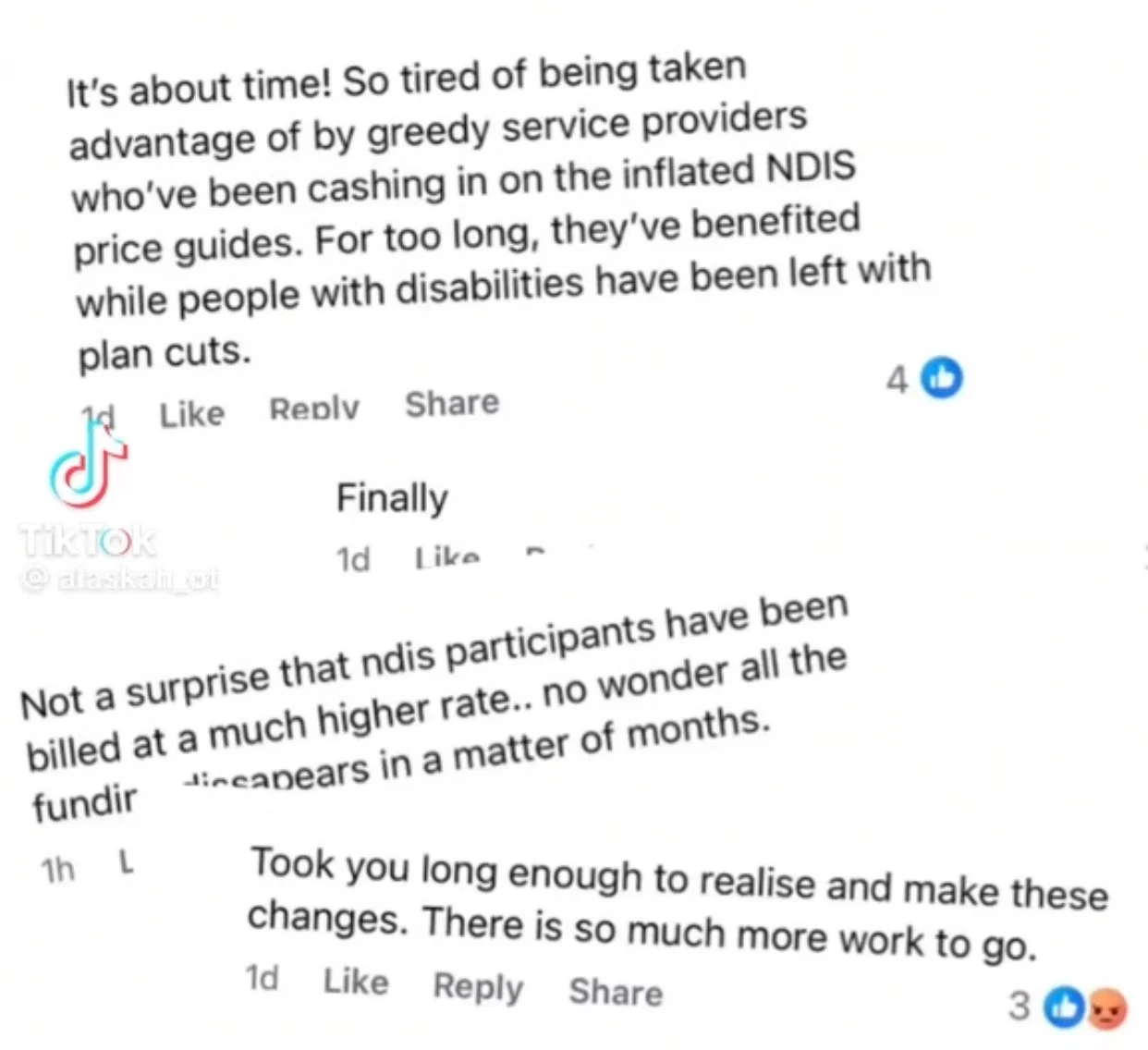
Screenshot taken from TikTok account @alaskah_ot displaying participant’s comments of the NDIS changes online.
One example of this from earlier this year includes a concerning story that a mother has shared on her TikTok account, in which she reports being recommended a behaviour therapist report for her child by their support coordinator. The behaviour therapist had a total of 3 meetings with the mother, who filled out numerous questionnaires, and the provider subsequently charged $6000 to their NDIS funds for the report. The provider didn’t even meet the child in question; the recipient of the NDIS supports.
You can watch the full video here: https://vt.tiktok.com/ZSkGNLB5n/
The above example of a report costing $6000 is an extreme case, as many behaviour practitioners would not charge such an exorbitant amount for a report, nor under deliver the service. A number of behaviour practitioners took to the comments to validate this extreme case of poor service delivery. Unfortunately, this example is not isolated, and many participants have similar stories of being overcharged for a service underdelivered.
Dodgy providers are certainly a valid and concerning issue for participants, and stories like these emphasize how vulnerable participants are being taken advantage of. These providers also create problems for genuine and compliant providers, as participants are understandably suspicious and mistrustful. When looking at examples such as these, it makes sense that many participants feel that it’s the fault of the providers for not ensuring services are accessible by reducing their fees.
Providers are unhappy with the NDIS.
Those most impacted by the changes such as Physios and other therapy providers, have also shared their concerns through social media, highlighting the difficulty they will have keeping up with increased demands, as they will now need to work more to earn the same income. Business owners and employees alike are united in their frustrations with the wages being frozen for the last 5 years for many services despite the ever-increasing cost of living, to now having a pay cut. For example, for physios in WA who will be hit the hardest, this is a $40 per hour decrease. This decrease in pay is still slightly higher than that of counsellors, who, despite being paid among the lowest rates of the allied health professions, have also not seen a pay increase in 5 years.
What does this mean for providers?
One NDIS provider, Selah (see-la), an OT and owner of Neuraffirm in Brisbane, has provided an informative and compassionate explanation on her Instagram account on how charging 50% of the hourly rate for travel will impact her business and ability to support participants. Selah shares that as a telehealth provider, she can bill a maximum of 5 to 6 hours per day of client-facing work, in line with most business’ KPI’s. The rest of her workday is filled with administrative tasks, such as caseload management, bookings, supervision and training. These administrative tasks are necessary for the work, however, can’t be billed. For sole traders, this work is done for free and often training and supervision comes at a cost to providers. In contrast with workdays where travel to participants is required, a travel time of 20 minutes to a participant’s home and then back, removes one billable hour from the day. If providers are traveling a lot, this can reduce the number of billable hours from 5 or 6, to now 3 or 4, cutting earnings in half. This means that out of an 8-hour workday, only half the day brings in any income. Selah shares that this has a large impact on the billing potential for businesses and sole traders, which may lead to more pressure on practitioners to meet higher KPI’s to bring in the same income, or businesses will no longer offer in-home services.
You can watch the whole video here: https://www.instagram.com/reel/DK_e2tHyHBV/?utm_source=ig_web_copy_link&igsh=eHIyNndmaXk2dm1u
While on a day-to-day basis, a loss of a couple hours of pay may seem small, it will accumulate quickly over weeks and months. A loss of 1-2 billable hours weekly means a loss of $200-$400 per week. In a month, that’s a loss of $1000 to $1600, and in a year, a loss of $11,000 to a whopping $17,600, based on a year with 4 weeks of annual leave. These changes will severely impact many businesses, especially small businesses and sole traders, who now have less than 2 weeks to prepare for it.
Are providers really price gouging and taking advantage of participants?
The short answer is no; genuine providers aren’t price gouging with charging the full fee.
Alaskah, a paediatric OT in Camden NSW, and owner of Rise and Thrive OT, has broken down the costs required to work as a sole trader who provides mobile therapy services. At a rate of $193.99 per hour for OTs working under the NDIS, Alaskah bills for 12 client appointments per week, plus an average of $32 per client for travel. Alaskah’s business costs include:
· Tax
· Student loan
· Medicare levy
· Superannuation
· Fuel/car expense
· Software subscriptions
· Professional registration
· Insurances and registrations
· Resources and materials
· Home office expenses
· Professional development
· Sick/annual leave
Excluding any unexpected business or personal costs.
These costs are very typical for allied health professionals and are quite small compared to other businesses who pay for office spaces, employees, and much more. After calculating these costs, her hourly take home rate lowers to $98 per client, and equalling about $1182 per week. Although Alaskah can only bill for 12 client hours, she works 20-25 hours per week in total, which brings her hourly rate to approximately $47-$60 per hour. This is in line with the pay rates for other highly skilled professionals.
You can watch the full video here: https://vt.tiktok.com/ZSkGSF4wK/
Although many participants and people of the public share the opinion that, if only providers would charge less than the full fee, this would allow participants to receive increased supports within their budget limit. However this places the burden of cost on providers with the expectation that providers reduce their fees out of generosity. There are very few industries, if any others, in which a highly skilled, trained professional with years of industry experience is expected to reduce their fees out of generosity. Most providers have completed at least a 4-year bachelor’s degree, if not a master’s degree as well, in addition to hundreds of hours of unpaid work . There are also high costs associated with maintaining insurance, registration and continuing education yearly to be able to work in the industry. Providers have studied and worked for many years towards achieving a role with an above-average wage.
Lots of genuine providers are already offering reduced rates, waiving fees or providing support pro bono to ensure their participants are receiving enough support. Even as a NDIS practitioner myself, I have waived travel costs or charged a reduced rate for a report if my participant hasn’t been provided enough funding by the NDIS to meet their needs. A recent study has shown that at least 66% of NDIS providers are currently running at a loss**. It’s evident that the genuine and compliant providers are already reducing fees, and these further reductions mean that some businesses may not survive.

Realistically, it’s the NDIS who should be footing the bill and ensuring participants are provided adequate funding based on the prices they have set out in their guides. In stark contrast to this, it’s been reported that the NDIS CEO earns $800k per year, which is more than that of our Prime Minister. It seems that, while the NDIS is trying to cut costs by reducing fees and reducing funding, the NDIS bosses are profiting big. Rather than participants vs. providers, it’s perhaps pertinent that we turn our attention to the funding body itself.
How does this impact participants?
Reduced fees may mean that many providers will go out of business, resulting in fewer providers to choose from and longer waitlists for support. Providers who will now need to increase the amount of work they are doing may become overworked, burnt out, and may not be able to provide the same level of support to each participant. The burden of travel may be placed on participants, and some providers will no longer offer in-home supports. This will hit regional and remote participants the hardest, who already have a lack of providers to choose from. Fewer providers offering in-home supports means that some regional and remote participants may be left without certain supports altogether.
The need for fair pay for providers does not take away from the legitimately poor service that participants have experienced with dodgy providers. Though it seems unfair to participants to advocate for all providers to receive increased pay, including the dodgy ones, in reality it’s unlikely to prevent those providers from overcharging fees. It will be the providers who are doing the right thing and are genuinely there to help who will be the ones impacted by this the most.
The original purpose of the NDIS was to increase access to supports, though this change makes things much more difficult for both provider and participant, when we are already seeing a reduction of hours funded across the board.
If you would like to support more positive change for NDIS providers, sign the petition to stop NDIS cuts:

BPsychSci, GDip Couns, MA Couns.
Certified Practicing Counsellor.