
A Practitioner’s Perspective: Commentary on the Royal Disability Commission and NDIS Independent review.
Published: January, 2025
As a counsellor providing support to clients with NDIS, I often bear witness to the ongoing difficulties of my clients in navigating the NDIS and disability sector. I have assisted clients to get on the NDIS through reports and supporting documents, and other clients to receive increased supports. I have witnessed clients be knocked back, and seen other clients struggle to obtain an adequate level of funding and support to maintain a satisfactory quality of life despite pervasive evidence of disability. I have seen providers who are overworked and struggling to meet clients’ needs while adhering to NDIS plans’ funding guidelines, and I have also seen exploitative providers, who have used the vulnerability of clients to gain trust and dictate the delegation of funds, often to the detriment of the client. There are many criticisms of the NDIS, but it’s importance cannot be emphasised enough.
Disability in Australia and the NDIS
As of 2022, 5.5 million Australians (1 in 5) are living with a disability, making up 21.4% of the total population (ABS, 2022). If you know more than five people, it is likely you will know at least one person living with a disability. People with disability experience a much lower quality of life than able-bodied people, with a much higher risk of experiencing poverty, homelessness, social isolation, receive less opportunities for education and community connection, and have worse mental health (Australian Human Rights Commission, 2014; Bishop et al., 2023). People with disabilities are also more likely to be victims of violence, with significantly higher reports of intimate partner violence, childhood abuse and neglect as well as discrimination and violence from healthcare providers and institutions (Hughes et al. 2012; Maclean et al., 2017; Fanslow et al., 2021; Lindsay at el., 2023; Cadwallader et al., 2018).
The legislation for the National Disability Insurance Scheme (NDIS) was introduced in 2013, with a full rollout of the scheme across Australia by 2020 (NDIS 2023a), providing funding for supports such as: daily tasks, transport to appointments, social activities, workplace assistance, therapeutic supports, help with household tasks, home modification, mobility equipment, and vehicle modifications (NDIS, 2021). The rollout of this support has changed the lives of hundreds of thousands of Australians with disabilities, who had previously never received support, now allowing the chance at an improved quality of life. By June of 2022, over 500,000 people were receiving NDIS supports, with more than 300,000 receiving the supports for the very first time (NDIS, 2023a), equating to 9% of the total population of people with disability in Australia receiving government funded disability support.
Figure 1.
Pie Chart of the Australian Populations of Able-bodied, People with a disability, and Supported People with disability.
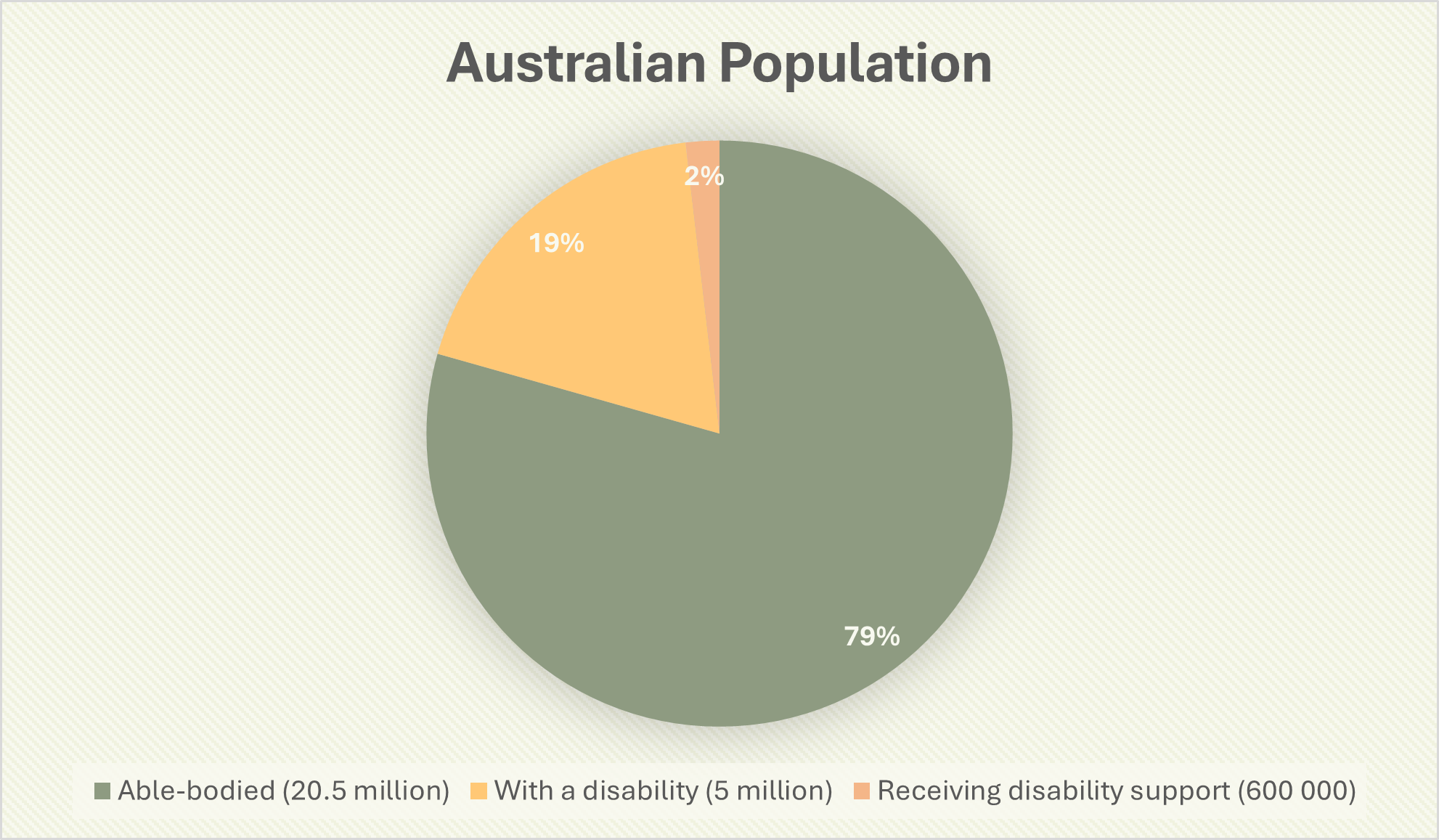
Note: Figure 1 displays approximate percentages according to ABS and NDIS population figures.
An evaluation of the NDIS shows that upon receipt of supports participants report feeling a stronger sense of choice and control, report increased wellbeing, improved development of skills and developmental progress, increased social and recreational opportunities, as well as an observed increase in overall happiness and quality of life (Mavromaras et al., 2018). Employment for young people in receipt of NDIS supports doubled (NDIS, 2023c). Overall, it appears the NDIS has increasingly facilitated positive improvements in the lives of many Australians with a disability in the past 4 years since its nation-wide rollout. Though, it is not without its criticisms.
Brief Overview of Royal Commission and NDIS Independent Review:
In what has been described as a ‘deeply disappointing’ and ‘underwhelming’ response by disability advocates (Canales, May & Convery, 2024a; McAlpine, 2024), the Labor Government approved in full only 13 of the 222 Royal Commission recommendations. Key criticisms by disability advocates include the lack of commitment to the fundamental recommendations of safeguarding people with disability from abuse and exploitation as outlined in Volume 6 of the report; having a reductionist and inadequate response to the level of research, evidence and recommendations at the same scale in which it was presented; and a failure to address the urgent needs for change (Cleal, 2024; Young, Campanella & Long, 2024; Kavanagh et al., 2024).
The response appears to demonstrate a heavy focus on workforce changes and employment support rather than legislative commitments towards disability rights, having pledged to invest $5.5 billion over the next 4 years to help people with disability find suitable employment, as opposed to a $6.9 million investment to review and modernise the Disability Discrimination Act (COA, 2024a). The Australian Human Rights Commissioner has further urged the government to take committed action towards strengthening laws and legislation around discrimination, upholding the rights of those with disability, and to demonstrate the seriousness with which the government has taken this report (Australian Human Rights Commission, 2024).
Criticisms towards the Labor governments response appear to be met with deflection of responsibility back to individuals, institutions, providers, employers, state governments or the community in general by the Ministers for the NDIS and Social Services, Bill Shorten and Amanda Rishworth.
The NDIS Amendment Bill 2024 was introduced to the House of Representatives in March 2024, and passed in the Senate by 22nd August 2024. The bill proposes a two-stream pathway for NDIS access, via early intervention or disability requirements, or both, which will see NDIS plans transition from a collection of ‘reasonable and necessary supports’, to a budget-focused plan able to be “spent more flexibly by the participant” (Pennings, 2024). The bill also announces a $14 billion funding cut over four years to the NDIS, citing ‘intraplan inflation’ as the area by which the savings will be derived from, as recommended by the NDIS review (Matthews, 2024). ‘Intraplan inflation’, described by Bill Shorten as “participant overspending”, is the top up of supports to participants once plan funding is exhausted. (cite)
During an interview with the ABC News, NDIS Minister Bill Shorten reported the current Labor Government has reduced the number of approved access requests to the NDIS from 36% approval to now 18% (ABC News, 2024), referring to the cut of necessary and crucial support access to Australians with disability by half as a budgeting success by the Labor Government.
Barriers to NDIS
It is no secret that attempts to receive support as a person with disability is an incredibly lengthy and strenuous task, often requiring multiple visits to GPs, expensive specialists, long wait lists, and numerous evidence reports in accordance with NDIS guidelines which can at times leave a participant waiting for months.
Numerous barriers reduce accessibility to healthcare providers, such as long wait times. A quarter of the population delay seeing a GP due to long wait times, being too busy, and lowered availability of services (AIHW, 2024). More than 39% of people in Australia waited longer than 24 hours for an urgent GP appointment, with more people reporting waiting longer than they felt acceptable for an appointment (ABS, 2022). Non-GP specialists can have months-long waitlists, with one report stating 6-9 month wait times for some private specialists (Vukasin, 2023). Waitlists for psychologists and psychiatrists are increasing, with more than 50% of participants waiting for up to 6 weeks, and 27% waiting longer than 2 months for an appointment (Lefebvre, 2023). Longer waiting times are also associated with increased health deterioration (Rastpour & McGregor, 2022), further increasing the need for additional future appointments.
Another barrier is the increasing cost of seeing medical and health care professionals (ABS, 2023). The cost of GP appointments doubled in 2023 (AIHW, 2024b), with fully bulk-billed GPs reducing to 1 in 4; an 11% national decrease in affordability with a current average out-of-pocket-cost of $41 per appointment (Gillespie, 2024). Costs of specialist appointments are far greater. Even with the assistance of the Medicare rebate, out-of-pocket costs for specialist appointments are anywhere between $85 to $176 for psychologists, psychiatrists and paediatricians (Mulraney et al., 2021).
Those with long-term health conditions were also more likely to require the care of three or more health professionals, and more likely to experiences issues due to a lack of communication between health professionals (ABS, 2023). This is made doubly hard by having multiple diagnoses and compounding disabilities, requiring double and triple the amount of time, effort, and money spent to obtain reports from numerous specialists.
The Cost of Applying for NDIS
To understand the difficulties of obtaining NDIS more simply, lets look at the process for applying for NDIS for a person who has only one diagnosis. Assuming the person applying has the capability to write their own application, has access to their own transport to appointments, is able to fund their own appointments, participate in the workforce and can afford to take time off, the process may look like this:
Figure 2.
Flow Chart for Process of Applying for NDIS for One Diagnosis.
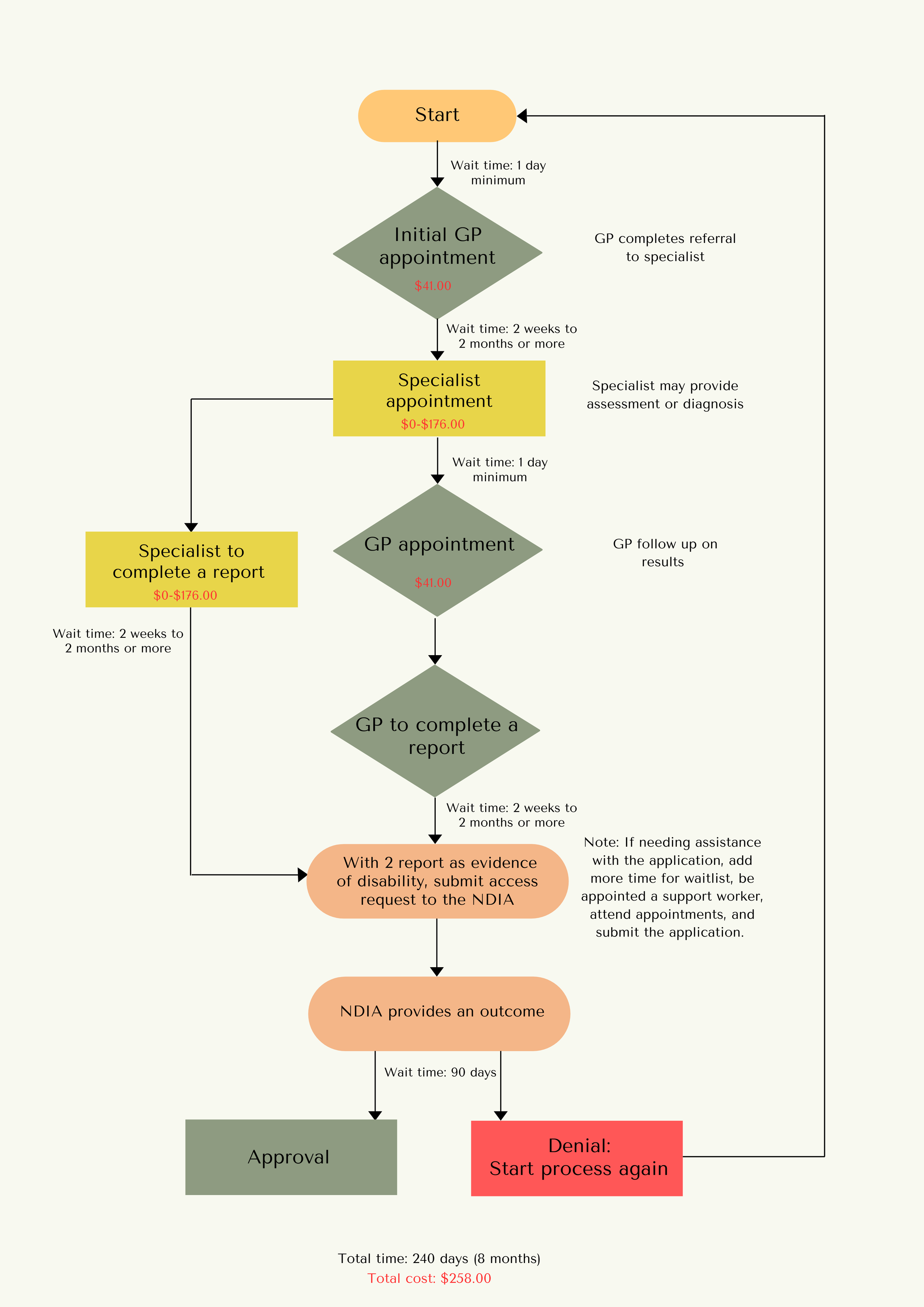
Note: The figures displayed in this chart are approximate and may vary person to person.
The total potential financial and time cost of applying for the NDIS for one diagnosis, is $258 and 240 days (8 months), excluding travel costs, cost of taking time off work, costs for additional appointment needs, as well as the toll the disability itself takes on the person and any life events that may impact on this process. Some specialists, such as psychiatrists, may also require 2 or more appointments prior to providing a diagnosis or writing a report.
If the outcome of the application is denied, start the process again. If the outcome of the application is approved, but the amount of supports the National Disability Insurance Agency (NDIA) has approved for the disability is not sufficient for a satisfactory quality of life, start the process again to provide additional evidence to the NDIA, while including added provider appointments with support coordinators, therapies, and specialists.
Evidently, the more complex the disability, the more difficult this process becomes. For example, the process for a person with 2 diagnoses may look like this:
Figure 3.
Gantt Chart of the Process for Applying for NDIS with Two Diagnoses.
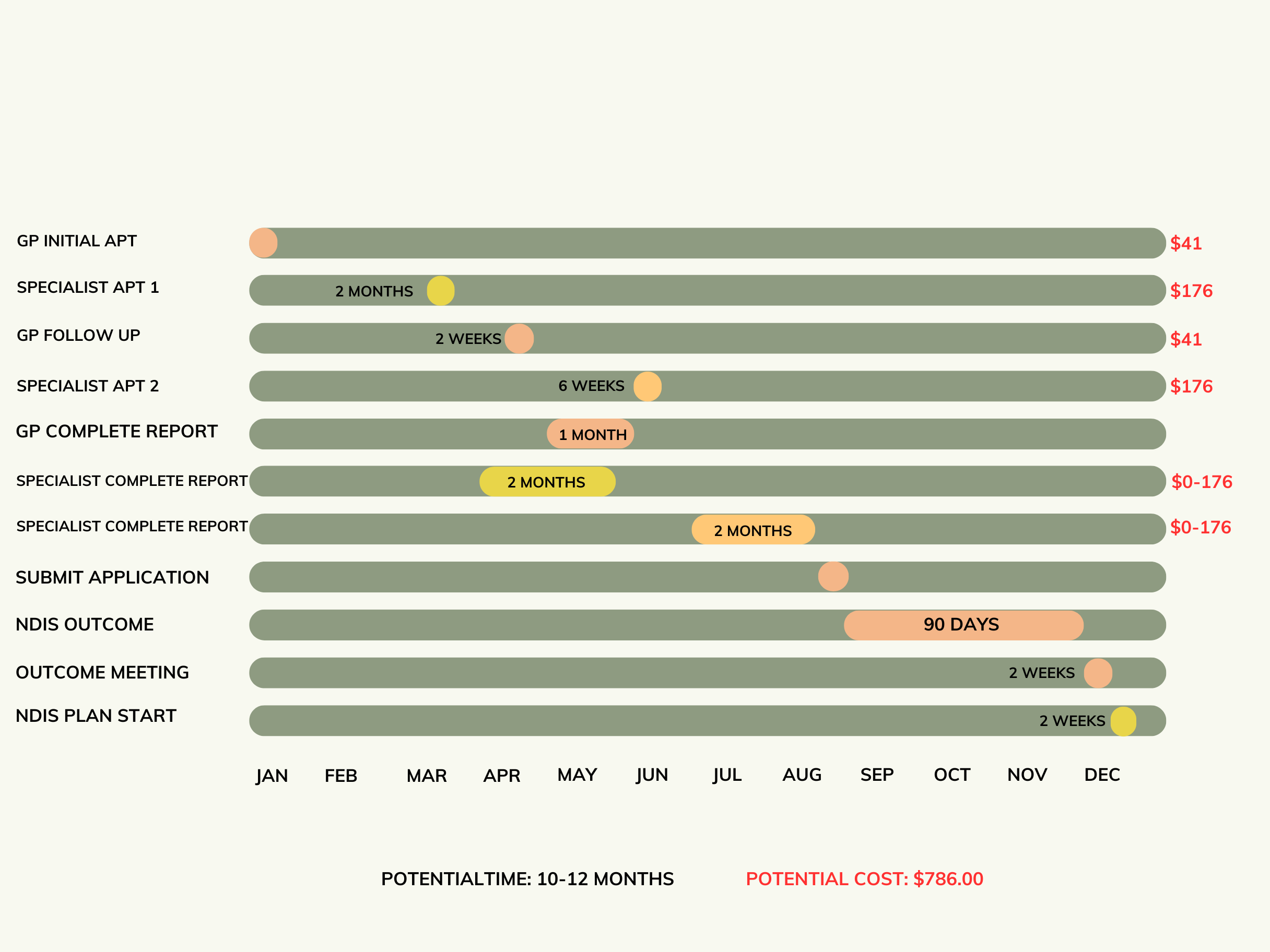
Note: The figures displayed in this chart are approximate and may vary person to person.
The potential time and financial cost for 2 diagnoses is 10-12 months and up to $786 if specialists charge for report writing. Again, this assumes the participant can complete the application themselves, does not rely on a support provider for assistance, no life events impact or delay the process, and the specialists only require seeing the participant once to complete a report.
To apply for the NDIS, almost one year of a person’s life is dedicated to this process. For an able-bodied person, this may sound tiring and inconvenient. For a person with disability, this process is exhausting and distressing, as it is the only process by which supports can be obtained and there is no guarantee all this work will result in approval.
NDIS Independent Review and Amendment Bill
It was announced in October 2023 there would be an independent review into the NDIS, aiming to investigate the processes and sustainability of the current model and deliver an improved experience to participants (NDIS, 2023d). The final report, released December 2023, concluded 26 recommendations and 139 supporting actions.
Recommendations included:
· legislation for better accessibility to supports with new early intervention strategies,
· new supports called “foundational supports” to be established available to anyone with a disability whether or not they are on NDIS,
· improved relationships between NDIS and support services such as mental health services,
· the inclusion of “navigators” to assist people with disability to connect with all supports available including non-NDIS supports,
· more funding flexibility,
· and making sure all providers are NDIS registered.
(NDIS, 2023b).
The result of the review concluded that the current NDIS model was financially unsustainable, noting that a significant amount of funding is lost to fraudulent providers, providers overcharging for supports (Pennings, 2024) and ‘intraplan inflation’, which is the top up of supports to participants once plan funding is exhausted (Matthews, 2024).
The NDIS Amendment Bill 2024 was introduced to the House of Representatives in March 2024, and passed in the Senate by 22nd August 2024, in support of majority of the recommendations made by the review.
The bill proposes some new changes:
· A new two-stream pathway for NDIS participants: an ‘early intervention’ stream and a ‘disability support’ stream for applicants, who will be categorised into one or both upon application approval,
· NDIS plans will be based on participant ‘impairments’, rather than diagnoses,
· NDIS plan budgets will change to a new budget-focused plan based on the outcome of an impairment assessment,
· New funding flexibility, meaning a plan will have “stated supports” (a list of supports they can access) and “flexible funding” (funding that can be flexibly used for a range of support options),
· Participants can apply for one support to be substituted for a different support if it seems more appropriate for them via a substitution application,
· Plans will always run for 12 months,
· Hiring of more NDIA employees, making it easier to contact the NDIA.
(Pennings, 2024; DSS, 2024).
The bill also announces a $14 billion funding cut over four years to the NDIS, stating that the savings will come from reducing plan funding top-ups prior to plan end dates (Matthews, 2024). Within this new framework, there is a “strengthened obligation” to remain within the funding limit, as funding will no longer rollover prior to the exhaustion of funds, and instead will require a change of circumstance application for increased funding.
This significant reduction in funding has been met with criticism from disability advocates, families, carers and people with disability as this will increase barriers to accessing adequate support. The bill has also been criticised for its limited detail and information on how these changes will affect participants, along with a lack of trust in the government’s ability to achieve their goals (Hegarty, 2024), with a report citing general trust in Australian public services is at just 61% (Australian Government, 2023).
A Practitioner’s Perspective:
As a practitioner working primarily with NDIS participants, numerous concerns come to mind.
Firstly, the government response to the commission appears to have a heavy focus on improving employment opportunities for people with disabilities, with half of the initial approvals falling within the category of employment. While this may lead to positive outcomes for improved opportunities for employment, skill development and inclusion in the workplace, it may also place increased pressure on Australians with disability to enter the workforce or increase current working hours despite almost half the population of people with disability only able to work part time (AIHW, 2024c). Furthermore, without the acceptance and implementation of committed discrimination policies in tandem with increased mainstream employment opportunities, Australians with disability may be at risk of experiencing the same level of stigma, prejudice and discrimination in the workplace with increased pressure to work (Ruhindwa, Randall & Cartmel, 2016). Evidently, the government’s response was budget-focused, missing a unique and historical opportunity to implement legislative policy ensuring the safety of Australians with disability, reframing and educating on the experience of people with disability, and improving access to supports for the 1 out of 5 Australians living with a disability.
Regarding the government’s response to the NDIS review, it can be reasonably expected that a new, innovative and first-of-its-kind policy, such as the NDIS, would likely undergo numerous adjustments in pursuit of growth, sustainability and improvement for its relevant stakeholders (i.e. users, providers, carers, and employees). In this case, substantial funding changes with the NDIS appear to be in response to a small few examples of funding misuse, however the evidence of such funding misuse that has been underscored in the media is still not available for public view. This is significantly incongruent with the conversations and experiences I have had and continue to have with dozens of participants, who are unable to receive assisted technology or support adaptations to their home necessary for their disability, despite having provided multiple reports evidencing their disability and need for such supports and waiting months for reviews from the NDIA. It appears somewhat of a miracle that some providers and participants have been able to obtain such substantial purchases, such as a $73,000 car (Chrysanthos, 2024) or a holiday to Japan, as mentioned by Minister for NDIS himself (ABC News, 2024).
The overall presentation of how funds are used by participants has not only been inaccurate and embellished, but further contributes to the stigmatisation and abuse of people with disabilities and of people in receipt of government financial support. Despite recommendations of the Royal Commission towards careful use of language, the emphasis on participants who “rort” the system, despite the lack of available evidence, is punitive in nature and directly opposes the original intent of the Royal Commission, with the inclusion of the Australian Human Rights Commissioner urging for a better response. The addition of application processes to obtain tailored and individualised supports for participants seems to further complicate the already convoluted process, particularly for those with multiple and compounding disabilities, those in rural and remote locations with less access to support, and those with “invisible” or complex supports needs. The process of application as referenced earlier, will be further compounded and lengthened with additional applications, additional support letters and reports, and longer waiting periods for participants to receive their necessary supports.
Overall, it appears the government’s intention is to transition people with disability into the workforce. This has benefits for some Australians with disability who can work and often find difficulty obtaining employment, and these individuals may find more inclusivity within mainstream workplaces. However, it does not seem to adequately safeguard people with complex and severe, and often lifelong, disabilities with a total or partial incapacity to work who rely significantly on NDIS supports and Disability Support Pensions. The emphasis on NDIS plans being ‘budget-focused’ is unclear, though it seems to mean that a participants will be provided a budget based upon evidence of impairment (no longer diagnosis), with which they must allocate their chosen supports for the year, with support to make these allocations (DSS, 2024). In this case, there is increased flexibility for supports which is certainly a positive change for many participants, however the allocation is likely to become more difficult the more complex a person’s disability needs. If funds are exhausted within the 12-month period, a reassessment of needs (‘change of circumstance’) will need to be submitted for additional funds as is the current process. The new framework, which is promised to be co-designed with the disability community, has not yet been fully fleshed out, so there is a lack of clarity and information about how this will impact at an individual level despite announcements of rollout as soon as 28 days from Royal Assent, meaning from formal acceptance by the Governor-general (Australian Government, n.d.).
The criticism about this lack of clarity, limited information, vagueness, as well as employment and budget-focused changes are valid, and the worry from the disability community and advocates is a reasonable response to changes that may lead to the harm and loss of valuable support to the most vulnerable populations.
More positively, the new changes may better support participants who require more flexibility with NDIS funds to suit their individual needs, and the increase in NDIA employees increases hopefulness in the ability for the NDIA to meet the needs of Australians with disability. After only four years from the full rollout of the NDIS, it is clear the NDIS is providing crucial and necessary supports evident by the increased demand to the scheme. Of 5.5 million Australians with disability, approximately 600,000 are now receiving support to live a quality life. Early intervention processes and new foundational supports to be accessed by people with disability not on the scheme may significantly improve the level of support available, as many may not need to rely solely on NDIS approval to receive the support they need. There is hope that the NDIS continues to make changes and improvements with the support needs of people with disability, families and carers in mind, and the inclusion of the disability community in the future design.
***It should be noted that while writing this commentary, the Minister for NDIS Bill Shorten announced his resignation from politics, and new position as Vice Chancellor at the University of Canberra by February of 2025 (Truu, 2024). It may also be relevant to note that one of the two independent reviewers of the NDIS is a current Chancellor at the University of Canberra, Lisa Paul.
References
ABC News. (2024, August 25). Reforming NDIS for future [Video]. Youtube. https://www.youtube.com/watch?v=TbBSinkQiOU
Australian Bureau of Statistics (ABS). (2022, November 18). More people waiting longer to see GPs for urgent medical care. Retrieved 2024, August 29 from https://www.abs.gov.au/media-centre/media-releases/more-people-waiting-longer-see-gps-urgent-medical-care.
Australian Bureau of Statistics (ABS). (2023, November 21). Patient Experiences. Retrieved 2024, August 28 from https://www.abs.gov.au/statistics/health/health-services/patient-experiences/latest-release.
Australian Human Rights Commission. (2014). Face the facts: Disability rights. Retrieved 2024, August 29 from https://humanrights.gov.au/our-work/education/statistics-and-factsheets-disability-rights#fn12
Australian Institute of Health and Welfare (AIHW). (2024b). General practice, allied health and other primary care services. Retrieved from https://www.aihw.gov.au/reports/primary-health-care/general-practice-allied-health-primary-care
Australian Government. (2023, November 21). Trust in Australian public services: 2023 Annual Report. Retrieved October 15, 2024, from https://www.apsreform.gov.au/resources/reports/trust-australian-public-services-2023-annual-report#:~:text=General%20trust%20in%20Australian%20public,no%20changes%20since%20last%20year.&text=People%20were%20most%20satisfied%20with,satisfied%20with%20public%20service%20processes.
Australian Public Service Commission (2018, May 22). APS values and code of conduct in practice. Retrieved 2024, September 15, from https://www.apsc.gov.au/publication/aps-values-and-code-conduct-practice/section-5-conflict-interest
Bishop, G. M., Kavanagh, A. M., Disney, G., & Aitken, Z. (2023). Trends in mental health inequalities for people with disability, Australia 2003 to 2020. Australian & New Zealand Journal of Psychiatry, 57(12), 1570-1579. https://journals.sagepub.com/doi/pdf/10.1177/00048674231193881
Department of Social Services (DSS). (2024, September 25). The NDIS Amendment Bill - questions and answers. Australian Government. https://www.dss.gov.au/disability-and-carers-programs-services-ndis-reforms/the-ndis-amendment-bill-questions-and-answers#amendments1
Fanslow, J. L., Malihi, Z. A., Hashemi, L., Gulliver, P. J., & McIntosh, T. K. (2021). Lifetime prevalence of intimate partner violence and disability: results from a population-based study in New Zealand. American journal of preventive medicine, 61(3), 320-328. https://www.sciencedirect.com/science/article/pii/S0749379721001914
Gillespie, J. (2024). Blue report: National general practitioner listings. Cleanbill. https://cleanbill.com.au/wp-content/uploads/2024/01/Cleanbill-Blue-Report-January-2024.pdf
Hegarty, N. (2024, May 16). Federal government $14 billion NDIS save set to be 'challenging'. ABC News. Retrieved: https://www.abc.net.au/news/2024-05-16/ndis-over-fears-of-eligibility/103853726
Hughes, K., Bellis, M. A., Jones, L., Wood, S., Bates, G., Eckley, L., ... & Officer, A. (2012). Prevalence and risk of violence against adults with disabilities: a systematic review and meta-analysis of observational studies. The Lancet, 379(9826), 1621-1629. DOI: 10.1016/S0140-6736(11)61851-5
Ireland, J. (2019, June 30). 'Stark conflict of interest': Bill Shorten says disability abuse royal commissioners must go. The Sydney Morning Herald. https://www.smh.com.au/politics/federal/stark-conflict-of-interest-bill-shorten-says-disability-abuse-royal-commissioners-must-go-20190730-p52c1k.html
James, S. (2024b, August 29). ‘Betrayal, failure and harm’: Jordon Steele-John blasts Labor over NDIS bill. Green Left, 1413. https://www.greenleft.org.au/content/betrayal-failure-and-harm-jordon-steele-john-blasts-labor-over-ndis-bill
Lefebvre, M. (2023). Under pressure: Australia’s mental health emergency. The McKell Institute. https://mckellinstitute.org.au/research/reports/under-pressure-australias-mental-health-emergency/
Lindsay, S., Fuentes, K., Ragunathan, S., Lamaj, L., & Dyson, J. (2023). Ableism within health care professions: a systematic review of the experiences and impact of discrimination against health care providers with disabilities. Disability and Rehabilitation, 45(17), 2715-2731.
Maclean, M. J., Sims, S., Bower, C., Leonard, H., Stanley, F. J., & O’Donnell, M. (2017). Maltreatment risk among children with disabilities. Pediatrics, 139(4).
Matthews, G. (2024, June 4). Labor cuts $14 billion from NDIS, with more to come. Green Left, 1407. Retrieved https://www.greenleft.org.au/content/labor-cuts-14-billion-ndis-more-come
Mavromaras, K., Moskos, M., Mahuteau, S., Isherwood, L., Goode, A., Walton, H., ... & Flavel, J. (2018). Evaluation of the NDIS. National Institute of Labour Studies Flinders University. https://apo.org.au/sites/default/files/resource-files/2018-04/apo-nid143516_1.pdf
Moon, E. & Ballard, T. (Hosts). (2024, September 1). ABC & Labor Vs Unions & NDIS ft. Jordon Steele-John (No. 141) [Audio podcast episode]. In Serious Danger. Michael Griffin. https://seriousdanger.com.au/
Mulraney, M., Lee, C., Freed, G., Sawyer, M., Coghill, D., Sciberras, E., Efron, D., & Hiscock, H. (2021). How long and how much? Wait times and costs for initial private child mental health appointments. Journal of paediatrics and child health, 57(4), 526–532. https://doi.org/10.1111/jpc.15253
Millar, R., Patty, A., & Massola, J. (2015, July 9). Royal commission: Bill Shorten accused of conflict of interest. The Sydney Morning Herald. https://www.smh.com.au/politics/federal/royal-commission-bill-shorten-accused-of-conflict-of-interest-20150709-gi8goi.html
National Disability Insurance Scheme (NDIS). (2021). Supports funded by the NDIS. https://www.ndis.gov.au/understanding/supports-funded-ndis
National Disability Insurance Scheme (NDIS). (2023a, July 12). History of the NDIS. https://www.ndis.gov.au/about-us/history-ndis#:~:text=The%20NDIS%20was%20legislated%20in,adults%20and%20children%20with%20disability.
National Disability Insurance Scheme (NDIS). (2023b, July 1). Media release from the Minister - A decade of transformation for people with disability [Press release]. https://www.ndis.gov.au/news/9345-media-release-minister-decade-transformation-people-disability
National Disability Insurance Scheme (NDIS). (2023c, November 14). Employment participation doubles for young NDIS participants. https://www.ndis.gov.au/news/9705-employment-participation-doubles-young-ndis-participants
National Disability Insurance Scheme (NDIS). (2023d, December 7). Landmark independent NDIS Review report released. https://www.ndis.gov.au/news/9737-landmark-independent-ndis-review-report-released
Pennings, S. (2024, June 25). National Disability Insurance Scheme. Parliament of Australia. Retrieved: https://www.aph.gov.au/About_Parliament/Parliamentary_departments/Parliamentary_Library/Budget/reviews/2024-25/NDIS
Rastpour, A., & McGregor, C. (2022). Predicting patient wait times by using highly deidentified data in mental health care: enhanced machine learning approach. JMIR Mental Health, 9(8), e38428. https://mental.jmir.org/2022/8/e38428/
Vukasin, F. (2023, May 25). GPs face mounting pressures as wait list crisis extends to private specialists. The Royal Australian College of General Practitioners. Retrieved 2024, August 31 from https://www1.racgp.org.au/newsgp/clinical/gps-face-mounting-pressures-as-wait-list-crisis-ex
How to cite this page:
McKenzie, S. (2025, January 17). A practitioner’s perspective: Commentary on the royal disability commission and NDIS independent review. Be Good Therapy. www.begoodtherapy.au/blog/practitioner-perspectivew-1-ndis